What does learning look like…
when we stop trying to capture it—
and begin to listen for it?
I was trained to look for evidence.
Clear outcomes.
Finished work.
Something I could point to and say—
“Here. This is learning.”
But in my classroom…
learning refused to sit still.
It flickered.
In a line drawn, erased, and drawn again.
In a student pausing mid-sentence—
searching for something not yet formed.
In the tension between ideas that didn’t quite fit.
These moments didn’t announce themselves.
They could have easily been missed.
And often… they were.
Until I began to notice.
Not just what students produced—
but what was unfolding as they worked.
What I began to see were traces—
small, partial, emerging signs of learning.
Moments that might otherwise slip past—
if I was only looking for what was complete.
And I started to understand something important:
If I only looked for finished products,
I would miss the very moments where learning was taking shape.
This is what Paul Black and Dylan Wiliam remind us of—
that learning is most powerfully shaped
in these formative, in-between spaces.
But only… if we respond.
So I shifted.
Not what students were doing—
but what I was attending to.
What I was beginning to experience was less about capturing learning—
and more about creating the conditions for it to arrive.
Because learning didn’t arrive fully formed.
It emerged—
through interaction,
through uncertainty,
through time.
As Lynn Fels and Michelle Searle remind us,
learning is not something we simply deliver—
it is something that arrives through attention, relationship, and time.
The design process became my way in.
Not as a sequence of steps—
but as a living structure where ideas could surface,
return,
and evolve.
A space where students could question, test, and reshape their thinking—
together.
Across understanding, defining, ideating, evaluating, prototyping, testing, making, sharing, and reflecting—
learning pulsed.
Not forward in a straight line—
but outward, inward, and back again.
And over time, I began to see these moments not as isolated—
but as points that were beginning to connect.
And I needed ways to stay with it.
Stickers to capture what I noticed—before it disappeared.
Reflection cards to make thinking visible.
Capacity self-assessments to trace growth across time.
Relational feedback—offered while learning was still unfolding.
These were not tools added onto assessment.
They were assessment.
A practice of attunement—
noticing what was emerging,
interpreting what it might mean,
and responding in ways that moved learning forward.
In these moments, I began to recognize what Lynn Fels describes as “tugs on the sleeve”—
moments that call us to pay attention.
Moments that ask us to stop.
And in that stopping—something shifts.
These interruptions were not breaks in learning—
they were openings.
Openings where something new could emerge—
if we were willing to stay.
So we stayed.
Because what once felt like frustration—
uncertainty, hesitation, disagreement—
began to reveal itself as part of the learning itself.
Not something to move past—
but something to work within.
Moments of tension became moments of possibility.
And as I stayed with these moments, something else became clear.
Learning was not confined to written output.
It was visual.
Oral.
Embodied.
Collaborative.
And as Carey Jewitt reminds us,
meaning is made across modes.
When I expanded what counted as evidence—
I expanded what I could notice.
And when I expanded what I could notice—
I changed how I could respond.
Over time, students began to trace their own learning.
They started to recognize patterns—
moments of tension,
moments of overlap,
moments of growth.
They moved from asking—
“Is this right?”
to wondering—
“What am I trying to understand?”
From completing tasks…
to engaging with ideas.
From dependence…
to agency.
And something deeper began to shift.
Not just what they could do—
but how they understood themselves as learners.
As Maxine Greene reminds us,
education is not only about knowing—
it's about becoming.
And in this work, becoming was not an abstract idea—
it became visible.
In how students reflected.
In how they collaborated.
In how they stayed with complexity.
And as Donna Ladkin highlights,
what happens inwardly shapes how we engage outwardly.
And as students became more aware of their own thinking—
their relationships to one another also shifted.
They listened more closely.
They responded more thoughtfully.
They built on one another’s ideas.
Learning became something shared.
What I began to see…
was not a series of isolated outcomes—
but a network.
When we mapped these moments—these traces—
what emerged looked something like this.
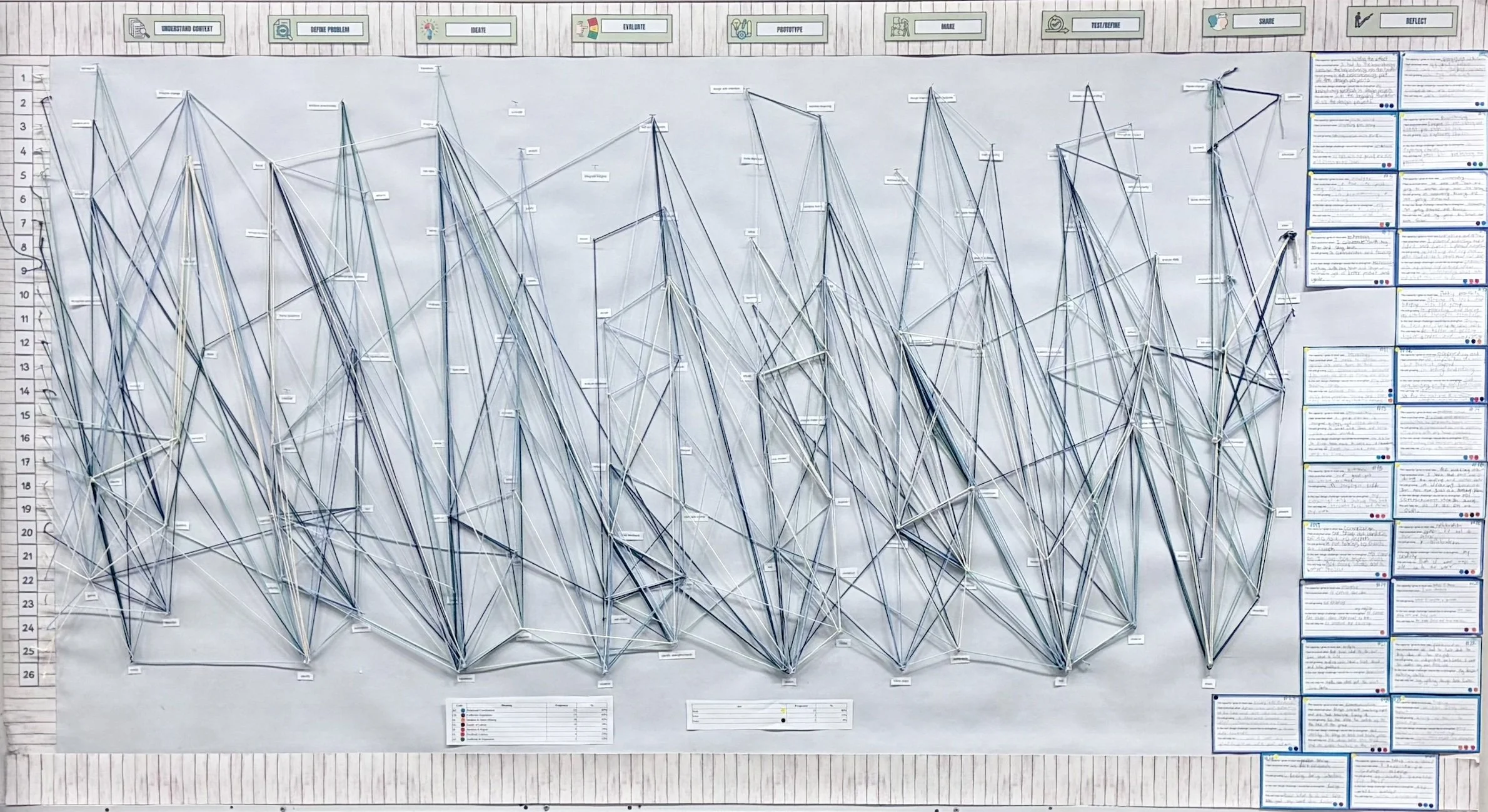
Points of connection,
Moments of overlap—
where students, ideas, and experiences met—
and reshaped one another over time.
And what we noticed…
was that these points of overlap that held the greatest growth
were also where the most tension lived.
These moments that asked the most of us—
to stay,
to listen,
to respond carefully,
was a living system of learning
And from this, a framework emerged.
Not imposed.
Not predetermined.
But noticed into being.
Assessment as attunement—
a practice of listening closely enough
to respond meaningfully.
And the design process—
not as a subject—
but as a spine.
Holding together planning,
observation,
response,
and reflection—
across subjects—
and across the many contexts where learning unfolds.
So what does this ask of us?
If learning is already happening in these moments—
in the unfinished,
the uncertain,
the in-between—
what are we missing
when we only assess what is complete?
What if assessment wasn’t something we did at the end—
but something we practiced
in how we pay attention?
In what we choose to notice…
in what we choose to respond to…
in what we choose to value.
And what if the design process—
not just in ADST,
but across our classrooms—
became the spine that helped us do this?
A way of tracing learning
as it unfolds—
across modes,
across time,
across relationships.
Because when we begin to see differently—
we begin to respond differently.
And when we respond differently—
new possibilities open.
Not only for what students can produce—
but for how they understand themselves
as learners,
as thinkers,
as contributors to a shared process of learning.
And in that shift—
assessment is no longer something we do to students.
It becomes something we do
with them.
And something they begin to do
for themselves.
Tracing not just what they know—
but who they are becoming.
Committee Feedback
April 15, 2026
Dear Crystal,
Congratulations on the successful completion of your Master of Education! And welcome to the world of scholarship, as evident from your presentation, an exciting example of knowledge mobilization (minus the final slides, which were unnecessary—trust that your words, the interplay of words with illustrations shared and reflected the depth of your inquiry and learning. Honestly, Crystal, you arrive as a curious and critical scholar, “well-beyond expectations at this level” (these are old words—inadequate as a way to celebrate your arrival as a scholar)! Your research journey as it unfolded in our presence and those of your colleagues and co-researchers is a celebration of an unexpected scholar who learns through disrupting the doing, attuning to what matters, and letting go of expectations to see what truly matters, attuning to each moment learning arrives.
From Making Learning Visible to Becoming Wide Awake: An Arts-Based Narrative Self-Study of Multiliteracies, Design, and Assessment
“They showed me what mattered before I had the language for it”
You have gifted us with a quantum leap in the field of assessment, introducing language, conceptual understanding, engaging in multi-modal and creative practices that enliven the field as you conceptualize and articulate assessment as attunement, inviting educators to consider ‘….how assessment might attend to learning as it unfold….”
Feedback as a catalyst is an enlivening concept—and, Crystal, I just couldn’t stop highlighting paragraphs as I read through your engaging inquiry paper, which easily could be a leading edge course on assessment and evaluation:
“I began to see that what I noticed was influenced by my expectations, my habits, and the frameworks I inherited. It was at this time that I realized that assessment was not simply a technical act of documentation; it was shaped by attention, interpretation, and relationship.”
“Creativity and making are not simply about producing something new, but about cultivating a way of being attentive and responsive to the world (Rubin, 2023). Through this lens, I see that making was more than an act of creation; it was a meaningful way of thinking, learning, and knowing.”
“I began to notice learning in moments of uncertainty, hesitation, and return where I had not noticed learning before, in instances where students lingered with materials, refined an idea over and over again, or helped each other through collaborative problem solving. My field notes highlight this shift and the process by which my focus drifted from completed products to tentative, embodied, and relational moments of learning.”
“The traces of learning that I began to notice included pauses, gestures, abandoned drafts, questions left unanswered, and choices made in the process of making. Noticing these traces was in line with literature that views learning as a process that unfolds over time, rather than a product to be identified at a particular point in time (Schön, 1983; McNiff, 2013). “
“These moments, as Fels (2012) describes, “interrupt the flow of the everyday and invite us to notice what matters” (p. 52). These moments did not arrive as clear insights or conclusions; they surfaced through uncertainty, material disruption, and narrative fragments that demanded I slow down, attend, and notice differently.”
It’s as though you marched through a continuum of theory, practice, and learning, to arrive to conceptualize and speak to “assessment as attunement”, Feedback as catalyst” – inviting new way to engage in research.
Postcards as “methodological artifacts!!!!), not only as artifacts, but as a way of engaging in inquiry, an invitation to educators and researchers to look to engaging in research through the \ practice of postcards (Fels, 2015), which you articulate so beautifully, as evident in the following—showing how inquiry, practice, reflection, and ethical attunement lead to new recognitions:
“In this way, these postcards became my narrative anchors, marking important turning points within my inquiry. They reveal the catalysts that reshaped how I notice, how I listen, and how I understand assessment as a living, relational practice—one that remains open to what is becoming. Rather than resolving uncertainty, these postcard moments redirected my attention away from certainty and justification toward ethical attunement. They helped me notice patterns and connections that were not immediately visible, helping me to see how my inquiry was unfolding temporally.”
“As I returned to my postcards, my questions continued to deepen rather than resolve and revisiting them allowed me to remain accountable to the moments that disrupted my assumptions. Returning also invited me to stay with these moments of uncertainty long enough for new understandings to emerge. In this way, my postcards functioned as orienting points within my inquiry, not by offering answers, but by teaching me how to remain with questions long enough for insights to emerge. Through sustained attention and repeated return, I developed a growing comfort with not knowing. I now see myself, not as someone who measures learning but as someone who attends to it as it unfolds.”
And to think that it all started with a cardboard box….
“While writing this postcard, I questioned whether this was parody, provocation, or personal gesture—perhaps it was all of these things. This stop moment (Applebaum, 1995) disrupted my assumptions about what counts as evidence of learning. The box in this scenario was functioning as a material narrative, insisting on its own value. It challenged me to reconsider how assessment practices might honour learning that appears beyond the confines of a lesson taped up, crossed out, and marked in red, rather than neatly completed.
“This moment underscores the importance of making space for what exceeds the plan: unexpected artifacts, uninvited gestures, emergent acts of creativity.” (Postcard excerpt, September 17, 2025)
The box arrives as the unexpected stranger (Derrida), and in your uncertainty, you offer hospitality. And that has made all the difference!
A wonderful journey of inquiry, that announces the arrival of a brilliant new researcher in our midst. I hope you continue your journey, Crystal, you have the heart of a researcher on a quest.
With care always,
Dr. Lynn Fels
Simon Fraser University ~ Faculty of Education
April 27, 2026
Dear Crystal
What a gift it was to walk alongside you on this final part of your journey. Although, I know it is not final for you, as your commitment to your continued learning is inspiring. Your inquiry is so beautifully textured, weaving together your own and your students’ learning with a breadth and depth of scholarship.
Your thinking (and living!) about assessment as attunement, paying attention to the traces of your students’ learning is such thought-provoking and important work Crystal. You have taken the traditional notion of assessment and turned it on its head, truly honouring the process of students' learning and enabling them to become both participants and witnesses to their own learning.
I was inspired by your thinking on following the traces of learning, enabling both you and your students to witness the unfolding of their learning, to as you say, ‘tracing not just what they know but who they are becoming.’ You have truly moved assessment into a visible process, where students become attuned to their own thinking and learning as both a shared and collective process. Something often spoken about but not often realized. …in this way, your work is groundbreaking Crystal!
What also stood out to me was your connection to assessment and learning as a living system. I have long resonated with Margaret Wheatley’s thinking on systems and leadership. I thought you might be interested in her thinking as you continue your leadership in sharing this work with your colleagues and the broader system. I attached the article this quote comes from for your interest.
It is the natural tendency of life to organize -- to seek greater levels of complexity and diversity…Everywhere you look you see that life is system-seeking. We are rediscovering our interconnectedness; there are no isolated individuals in the natural world. Life seeks to affiliate with other life, and as it does that it makes more possibilities available, it makes more diversity possible.
I think life seeks systems because systems allow more diversity, they allow individuals to thrive, and they give each of us (when we're in a healthy functioning system) more freedom to experiment with what we want to be as long as we remain conscious of our connections to the whole of the system. To repeat: Life is self-organizing. It seeks to create patterns, structures, organization, without pre-planned directive leadership.
Your ‘commitment to assessment as an ethical and relational practice—one that honours becoming, resists closure and remains open to what learning might become’ does indeed ‘honour the humanity of our work with our students.’ Simply brilliant work Crystal
Congratulations Crystal! Micheal and I leave you with a poem from the Hopi Elders, you are the ‘one we have been waiting for’.
To My Fellow Swimmers
Here is the river flowing now very fast.
It is so great and swift that there are those
Who will be afraid, who will try
To hold on to the shore.
They are being torn apart and will suffer greatly.
Know that the river has its destination.
The elders say we must let go of the shore.
Push off into the middle of the river,
And keep our heads above water.
And I say see who is there with you
And celebrate.
At this time in history,
We are to take nothing personally,
Least of all ourselves,
For the moment we do,
Our spiritual growth and journey come to a halt.
The time of the lone wolf is over.
Gather yourselves.
Banish the world struggle from your attitude
And vocabulary.
All that we do now must be done
In a sacred manner and in celebration.
For we are the ones we have been waiting for.
From the Elders of the Hopi Nation
Introduction to Perseverance by Margaret Wheatley
Dr. Susan Montabello & Dr. Michael Ling'
Simon Fraser University ~ Faculty of Education